
By T.J. ENGLISH
I sometimes get asked why I don’t write about white collar criminals. Implied in the questions is the inference that white collar criminals, financially speaking, are certainly as much a menace to society as the gangsters I write about. I do agree with the premise. In America, white collar criminals are the true scourges of society. But there is a simple reason I don’t often write about them. They are boring.
I read the stories about them in the news – Kozlowski, Madoff, and this recent douche bag, Martin Shkreli, who marked up AIDS medication by five thousand percent and was recently arrested for securities fraud. These are people whose financial crimes are worse than the average organized crime family. They are certainly worse than, say, a street gang; their crimes do more damage to society than most gangsters.

But here’s the problem: most of them are “true blue Americans,” white men with wives and kids who live in garish mansions inside gated communities. Their version of the American Dream is the most unimaginative and shallow ever conceived. It’s based on acquisitiveness, and nothing more. It is crass and devoid of morality. Disgusting and pernicious? Yes. But also boring. Their daily lives are filled with nothing. The storyteller in me dies a little bit every time I read about their activities.
When I write about the criminal underworld – be it from the POV of my own Irish American culture, or Cuban American culture, or African American, or Mexican – it is from a place of respect and curiosity (curiosity being the highest form of respect) for the culture I’m writing about. I write about an aspect of that culture in which people are shut out from the mainstream, and they are struggling to become a part of that tapestry. In the underworld, violence and crime are the dominant transactional methods available; they always have been. The means by which outcasts and “suspicious characters” navigate this world is endlessly fascinating to me. It is the true American story.
White collar crime has no larger narrative. Sometimes, a storyteller will try to make something of the lives of Wall Street vampires, or hedge fund con men, or corporate predators by focusing on the excess. Perhaps there is drama and entertainment value to be found in the gleeful immorality of their lives (see: Martin Scorsese’s The Wolf of Wall Street). Doesn’t work for me. Greed as a motive is the most base and least interesting of all the Deadly Sins. It is mundane and lacks heart. It is boring.
So, yes, I will read the accounts in the media of those capitalist pigs who choke on their own gluttony, or those who are still getting away with it. It is important to stay informed, and to know who are the true criminals. Just don’t ask me to engage my imagination in their narratives. If you are so concerned, then you write those stories.
I would much rather spend my creative energy or my time with a street hoodlum than a CEO. I would rather do research in a Kingston tenement yard or a colonia in Ciudad Juarez than in a corporate boardroom. White collar crime may be an important subject, it may be worthy of discussion, but for a storyteller, it is about as nourishing as a speech by Donald Trump.
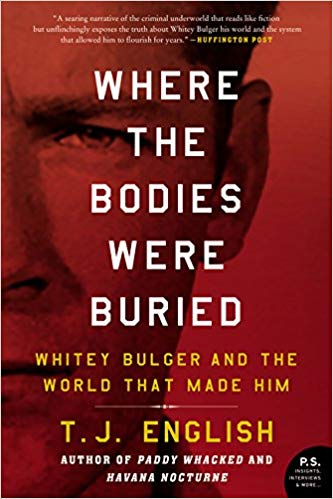
 o sell hundreds of thousands of copies. Since its initial publication in 1990, The Westies has never been out of print.
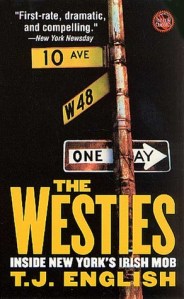 nown primarily for the level of savage violence that characterized their criminal activities in the 1970s and 1980s. Specifically, they developed a macabre reputation for making their murder victims bodies “do the Houdini.” After they killed someone, they cut the bodies into pieces, bagged the body parts and dumped them into the East River. Eventually, the gang’s criminal activities came to the attention of the Mafia. Led by Coonan, the gang sought to establish a working partnership with the Gambino Crime Family, who were led at the time by Paul Castellano. This partnership, hotly debated within the gang, would eventually sow the seeds of the gang’s destruction.
 panning more than twenty years, captured the imagination of the young journalist and cab driver, himself an Irish American from a working-class background. What made it possible for this neophyte, would-be author to sell the story to a major publisher was that English saw this yarn in the larger context of the Irish American experience. The book became about something more than the story of this particular criminal group from this particular neighborhood. It became the story of a certain type of hard-nosed, tough guy Irish American culture that had existed in many U.S. cities for nearly a century.
 streetlogicblog.com